Level 36: ALU
Task
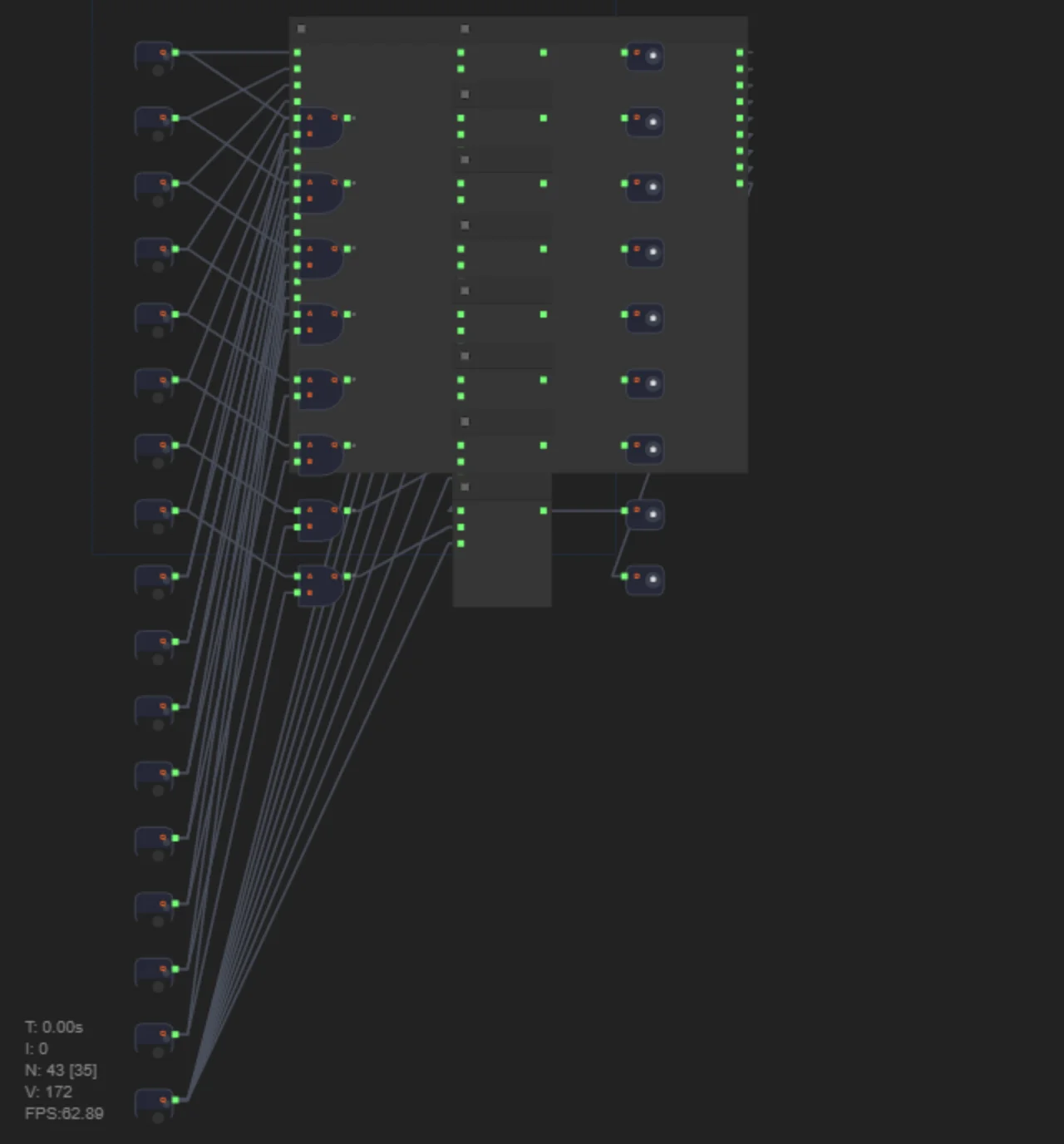
Build an 8-bit Arithmetic Logic Unit (ALU). When op_code = 0, the module performs addition; when op_code = 1, it performs bitwise AND.
Module ALU8 takes two 8-bit buses (a[7:0], b[7:0]), a 1-bit op_code, and outputs out[7:0] and carry_out.
Use the Adder8 (level 35) and Mux (level 32) modules.
Key insight: in hardware, both results compute in parallel, and an array of multiplexers selects which one reaches the output.
Solution for self-check
Try building the circuit yourself first. The solution below is a way to check yourself if you're stuck or have already solved it.
The in-game hint on this level inserts a code scaffold: without two Mux lines (m3 and m6) — output bits 3 and 6 are never selected. Write the lines yourself following the neighbouring ones.
The ALU is a classic example of hardware parallelism: both results (addition and bitwise AND) are computed simultaneously, and multiplexers select the right one.
Port order of Adder8: (sum, c_out, a, b, c_in). Leave c_in unconnected — it defaults to 0, correct for addition.
Port order of Mux: (out, a, b, sel).
- Declare two 8-bit buses for intermediate results:
wire [7:0] out_add, out_and; - Instantiate the 8-bit adder — the addition path:
Adder8 adder(out_add, carry_out, a, b); - Compute bitwise AND — 8
andgates, one per bit:and aa0(out_and[0], a[0], b[0]);and aa1(out_and[1], a[1], b[1]);… throughand aa7(out_and[7], a[7], b[7]); - Select the result through 8 multiplexers — all controlled by the same
op_code:Mux m0(out[0], out_add[0], out_and[0], op_code);Mux m1(out[1], out_add[1], out_and[1], op_code);… throughMux m7(out[7], out_add[7], out_and[7], op_code);
carry_out is wired directly from Adder8 — it is valid for any op_code.