0 and 1: The Language Machines Speak
Computers seem incredibly smart, but in reality, they don't understand human language at all. They don't know letters, don't understand numbers the way we do, and have no clue what internet memes are. All they have is electricity.
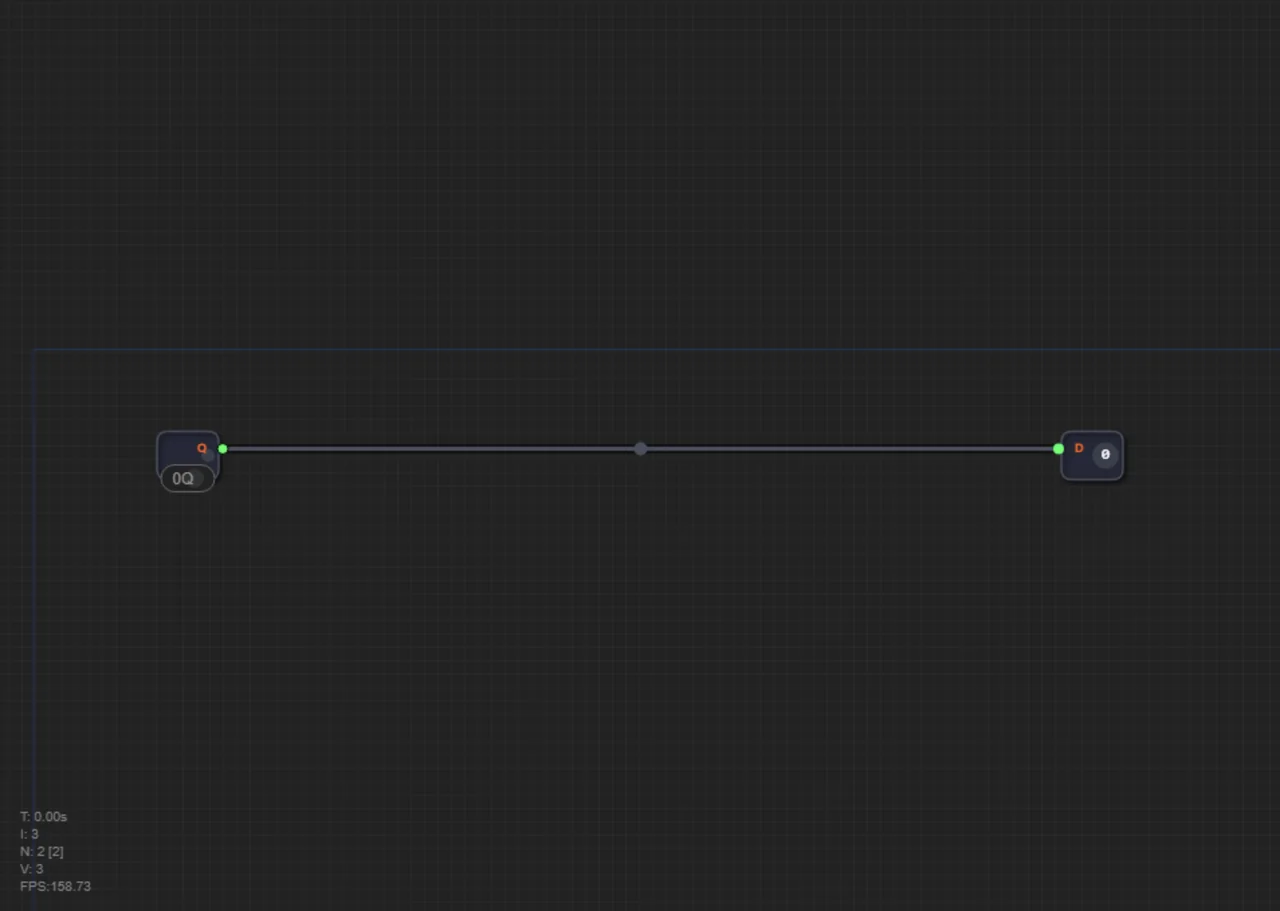
Imagine an ordinary light bulb and a switch. The bulb has only two states: it's either on or off. A processor works exactly the same way. Inside it are billions of tiny switches — transistors. When current flows through a wire (high voltage), the computer treats it as a "yes" or one (1). When there's no current (low voltage) — it's a "no" or zero (0).
This system is called binary code. All the magic of computing is built on the fact that combinations of these zeros and ones can encode absolutely any information: from a simple number to complex 3D graphics in modern games. And it all starts with the simplest action — sending a signal along a wire.
The transistor — a switch hidden in silicon
A transistor works like a faucet in a water pipe: a small signal on the "handle" controls a large flow. But for us, its other property matters more — it can be in exactly two states: "open" (current flows, that's 1) or "closed" (no current, that's 0). There is no intermediate position.
That's why computers don't use the decimal system: a transistor would have a very hard time storing ten different voltage levels — far too much room for error. Two states are cheap, reliable, and simple. Everything else is just a matter of combinations.
Bits and bytes
One such signal — 0 or 1 — is called a bit. Bits are grouped together: 8 bits make a byte. Each bit of a byte can take 2 values, so a byte stores 2 × 2 × 2 × 2 × 2 × 2 × 2 × 2 = 28 = 256 different values — the numbers from 0 to 255. That's enough to encode any letter of the alphabet, digit, or symbol.
Powers of two: how binary counts
In the decimal system, the place values are 1, 10, 100, 1000. In binary, they are the powers of two: 1, 2, 4, 8, 16, 32, 64, 128. Each next position is exactly twice the previous one.
Let's work out the number 65 step by step. We go from the most significant place (128) to the least significant (1):
128 is greater than 65 → write 0
64  fits into 65 → write 1, remainder 1
32  is greater than 1 → write 0
16  is greater than 1 → write 0
8   is greater than 1 → write 0
4   is greater than 1 → write 0
2   is greater than 1 → write 0
1   fits into 1 → write 1, remainder 0
Collect the digits in order: 01000001. That's the binary form of the number 65 — the very form in which the letter "A" is stored.
The first 16 numbers in binary
The easiest way to remember the system is to look at small numbers:
| Decimal | Binary (4 bits) |
|---|---|
| 0 | 0000 |
| 1 | 0001 |
| 2 | 0010 |
| 3 | 0011 |
| 4 | 0100 |
| 5 | 0101 |
| 6 | 0110 |
| 7 | 0111 |
| 8 | 1000 |
| 9 | 1001 |
| 10 | 1010 |
| 11 | 1011 |
| 12 | 1100 |
| 13 | 1101 |
| 14 | 1110 |
| 15 | 1111 |
When a binary number "overflows", it simply adds a new digit on the left — exactly like the decimal system when 10 follows 9.
Why the letter "A" is 01000001
Letters are numbers inside a computer too. In the ASCII table, every letter has its own number: "A" is 65, which is 01000001. That's why when you press a key on your keyboard, the controller sends the processor not a letter, but a byte of eight zeros and ones.
All the text in this article, every pixel on your screen, and every note in the music you listen to — everything boils down to long chains of these bits. We're simply used to seeing the result already "translated" into a human language.
Summary
Practice converting numbers between binary and decimal in the number base converter.
1. A computer understands only two states: current present (1) and no current (0).
2. A transistor is a two-state switch, and all chips are built from them.
3. One bit is one binary digit; 8 bits make a byte, which stores 256 values (0–255).
4. Binary place values are the powers of two: 1, 2, 4, 8, 16, 32, 64, 128.
5. Any data — text, images, sound — is stored as chains of bits (the letter "A" is 01000001).
In level 1.1 you will build the very first wire: send a signal 1 from a source to a receiver and watch the "light turn on" at the output. This is the first step toward truly controlling electricity. To learn more about why machines speak the language of two states, read the introduction to circuitry, and next up are the AND, OR, NOT gates.