Why the Ershov Computer teaches: the methodology of the course
The Ershov Computer is a free browser course in which a student builds a computer with their own hands: from a wire and a NAND gate to an 8-bit processor, assembly language, Verilog and — in an optional finale — a real FPGA board. This page explains why the course is designed the way it is: behind every game mechanic there is a pedagogical technique that we call by its name and explain in terms of the job it does.
Why understand the hardware
Programming at school is often taught as text: variables, loops, functions. In that approach the computer can remain a black box that runs code for some reason: the student can write programs but has no picture of how a processor executes instructions or what role registers, clocking and buses play. The gap makes itself felt wherever computer architecture begins — and it has to be handled with nothing to lean on.
The course takes its name from the idea of Academician Andrei Ershov that programming is a "second literacy" mandatory for every educated person. We develop this idea in the direction of understanding how computing machinery is built: before studying the computer as a ready-made system, the student gets acquainted with logic elements, memory and the principles of processor design. Where the project came from and why it carries Ershov's name is told on the About page; this page is about something else — about how the teaching itself is built.
The course's second foundation is Seymour Papert's constructionism (the book "Mindstorms", 1980): people build mental models most reliably when they construct a working, publicly shared object in the outside world — what Papert called objects-to-think-with. A student of the Ershov Computer does not read about an adder — they build the adder, and the finished circuit then keeps working at their side. A historical detail: Papert, Piaget's student and the creator of the Logo language, corresponded with Academician Ershov and discussed teaching schoolchildren with computers — the idea that programming becomes a second literacy through one's own projects was common ground for both of them.
The course map: four parts and one spiral
The course consists of 47 levels in four parts:
- Part 1 (levels 1–16), "Basic circuits": wires, gates, adders, buses and memory elements — from a truth table to the first processor unit, the program counter.
- Part 2 (levels 17–29), "Advanced architecture": from the decoder to your own 8-bit processor and programs in assembly — up to the final level, "Snake".
- Part 3 (levels 30–43): the same material in the Verilog hardware description language — text instead of a canvas.
- Part 4 (levels 44–47): porting the project to a real Tang Nano 9K board. The levels themselves are completed in the browser — the board's peripherals (buttons, LEDs) are emulated on the canvas; a physical board is needed only for the optional final step of building your own project in real hardware.
Behind this sequence stands Jerome Bruner's idea of a spiral curriculum. In "The Process of Education" (1960) he argued that the key ideas of a subject can be presented to students of any age in an intellectually honest form they can grasp, and then revisited again and again, each time at a deeper level. In this course the spiral is plain to see: an adder is first wired from gates on the canvas (levels 6–8), then it reappears inside the ALU (levels 13–14), and later it is described in Verilog (part 3) — several passes over the same circuit with growing depth.
The second foundation is Lev Vygotsky's zone of proximal development (works of the 1920s–30s): learning works when the task is slightly harder than what the student can solve alone, yet solvable with support. Gradual complication by itself is the "from simple to complex" didactic sequence known since Comenius; Vygotsky's contribution is different: a level counts as within reach if, with a hint, a sample circuit or an error walkthrough, the student arrives at a solution they have not yet found on their own. The typical duration of every level is known in advance, and the curriculum timeline of all 47 levels shows where each topic appears.

Course mechanics and their foundations
What follows are the eleven mechanics the course is made of. The format is the same for each: what the mechanic does, what it is for, and which pedagogical technique stands behind it.
Incremental difficulty and component discovery
New components are not handed out as a list: they unlock as you progress, and each next level requires only what has already been mastered. This is the "from simple to complex" sequence — a basic didactic technique that works like sequencing in game design. Separately, scaffolding is at work (Wood, Bruner and Ross, 1976): temporary supports, provided as needed and removed as skill grows. In this course those are the pre-assembled parts of a circuit at a level's start, the two-stage hints and the templates that disappear from level to level. And when a student packages a finished circuit into a chip and then uses it as a ready-made block, something else happens: not the removal of supports but chunking — encapsulation that lowers cognitive load.
Chips: abstraction as a tool
A finished circuit can be packaged into a chip — your own component with an interface of inputs and outputs. The course then insists on this packaging: building the processor requires using the chips you have created earlier. The technique anchors the main engineering skill of building hierarchies of abstractions. It also works in reverse from level 30 on: when a circuit is described as Verilog text, the student already knows that a set of gates stands behind the text, because they wired those gates by hand.
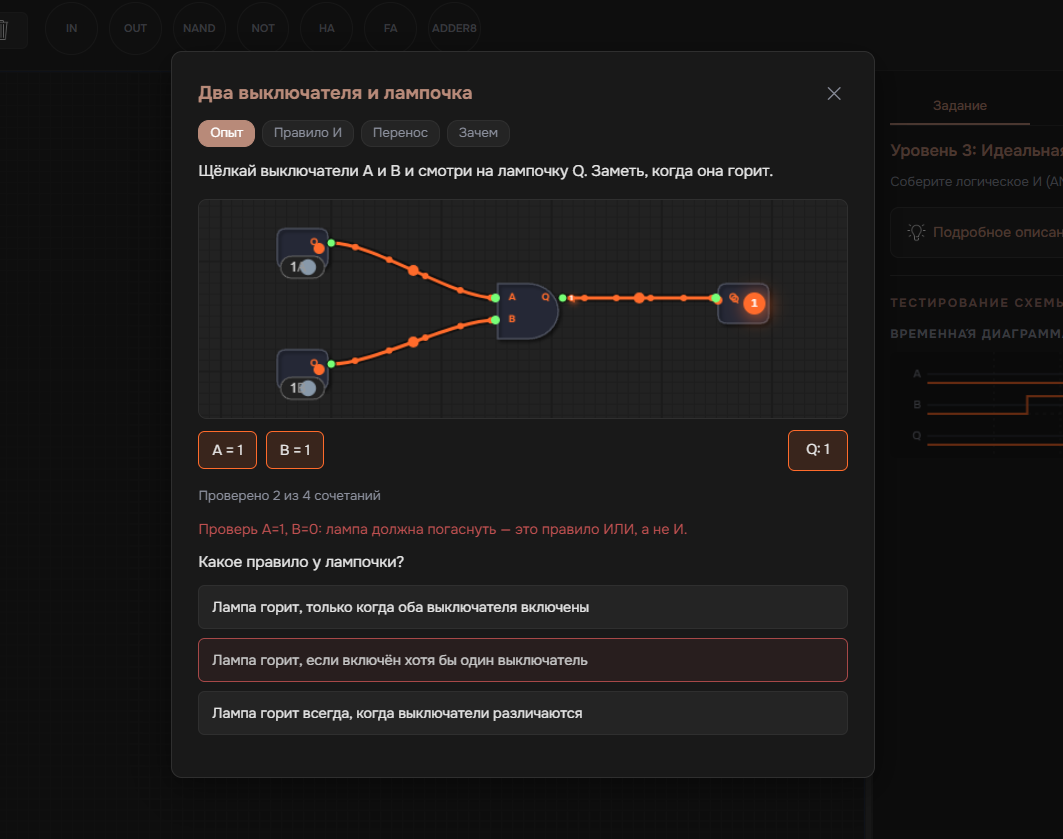
Concept checks: prediction, experiment, counterexample
After levels, the course asks comprehension questions of three kinds: multiple choice, predicting a circuit's behaviour before running it, and dissecting a broken circuit ("break it"). Together with check diagnostics this is formative assessment in the strict sense (Black and Wiliam, "Inside the Black Box", 1998): evidence is gathered continuously, inside the learning process, to tune it — not to assign a mark. The core of the concept checks is the Predict–Observe–Explain technique (White and Gunstone, the collection "Probing Understanding", 1992): the student records a prediction of a system's behaviour, then observes the result and explains any discrepancy. This format exposes misconceptions that a plain quiz misses. And tasks where the student produces an answer of their own, rather than picking a ready-made one, lean on the generation effect (Slamecka and Graf, 1978): material earned by one's own inference is remembered better than material handed over ready-made.
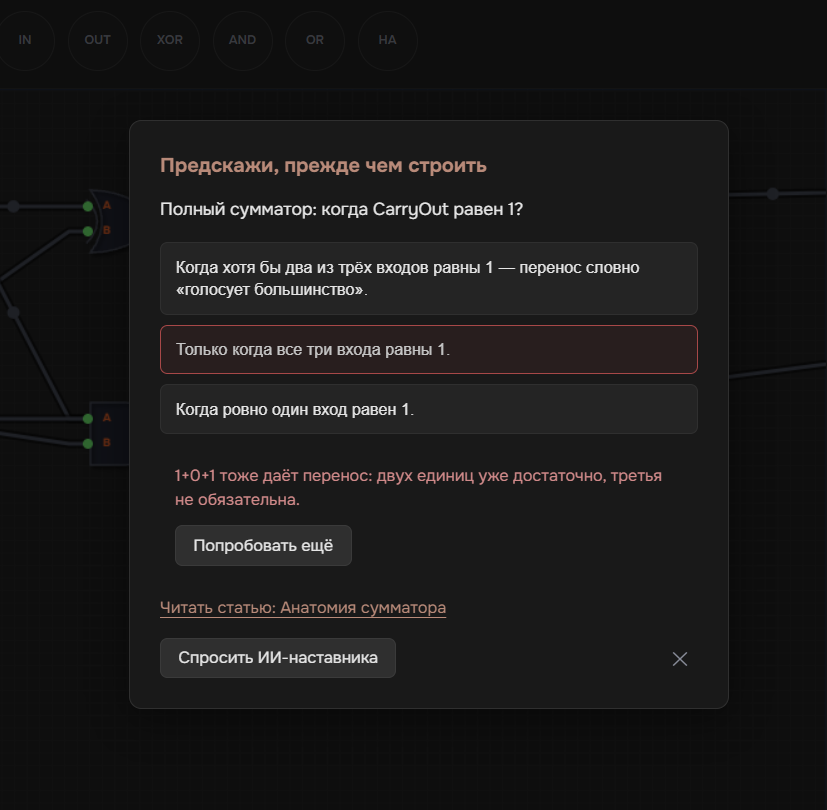
The calibration prediction before the first check
Before the first check of a circuit, the course asks whether it will pass the tests. This is an exercise in metacognition: research on judgments of learning, the field John Dunlosky works in with co-authors, shows that a student's confidence often diverges from the actual state of affairs, and the accuracy of such self-assessments is a skill of its own. The most vivid lesson here is putting confidence ("the circuit is correct") next to the tests' verdict ("short circuit found"): the prediction and the check result are visible side by side, and a divergence is impossible to miss.

Two-stage hints and the Socratic AI tutor
A hint takes two clicks: the first points in a direction, the second gives a concrete step. The AI tutor answers with guiding questions instead of a ready solution and moves to direct answers only after a series of failures. The course tries to keep the balance between independent search for a solution and timely support: in John Hattie's meta-analysis "Visible Learning" (2009), feedback is among the factors with a high effect size — but measure matters too: handing out solutions wholesale takes the problem off the student's shoulders, while silence leaves them alone with it. The hint holds that balance.
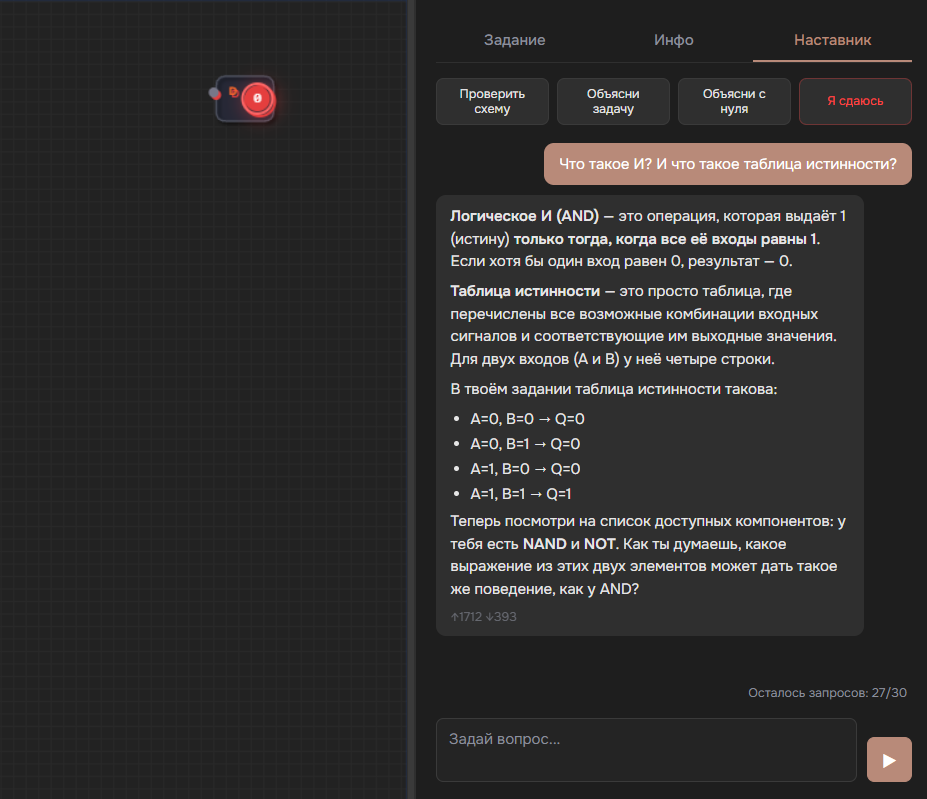
Auto-help after 3 and 7 failures
If a check fails three times, the course offers a walkthrough; after the seventh failure, a more direct one. Here the course walks the line described by Productive Failure (Manu Kapur, works of the 2010s): one's own unsuccessful attempts before a solution is explained accelerate subsequent learning — but only up to the point where struggle turns into unproductive frustration and cognitive overload (John Sweller's cognitive load theory), and a stuck student simply abandons the task. The thresholds of 3 and 7 attempts are a product decision meant to offer support before that line; how well they work is judged by how students actually behave.
The "Basics" intros
Before a number of levels, a short intro is offered: what the element is, what it is for, how it looks in real hardware. These are David Ausubel's advance organizers (a paper in the Journal of Educational Psychology, 1960): a frame given before new material that lowers the load of absorbing it. The intros are optional and do not unlock levels — they give a preliminary picture of the new concept, which the student then tests in practice.
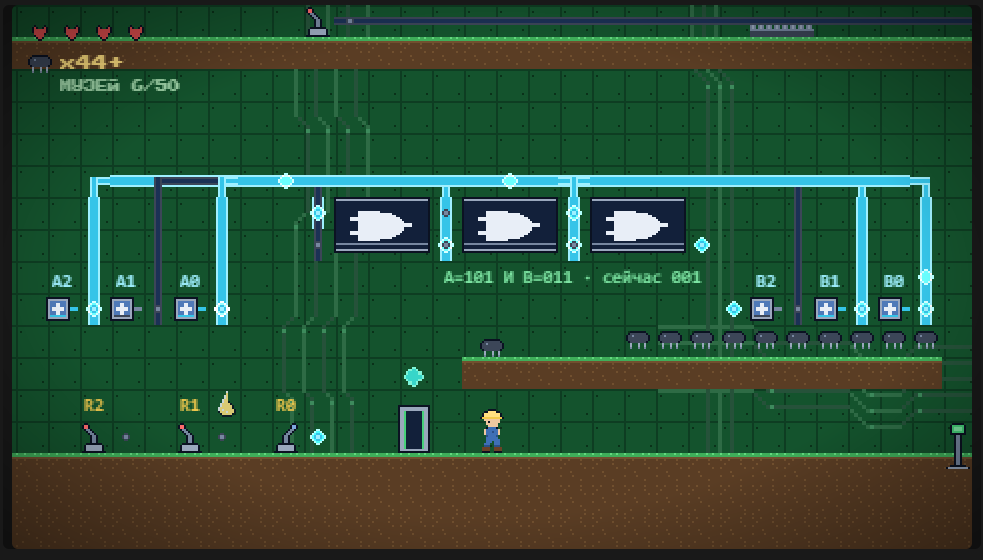
The Transistor Run platformer
After the first teaching levels, a platformer opens where the same logic is rehearsed in a game world: a circuit from a power source to a door is assembled mid-run, and the gates you have studied appear as rooms and mechanisms. Behind the motivational side stands the self-determination theory of Richard Ryan and Edward Deci (a review in American Psychologist, 2000): intrinsic motivation rests on autonomy, competence and relatedness, and a game format can support the first two — whether it truly strengthens motivation depends on how the mechanics are implemented and on the players' experience. Behind the content side is revisiting covered material: familiar concepts return in a new form and a new context, giving one more pass over the material. More about the game is on the Transistor Run page.
The placement test
27 questions and 3 hands-on tasks before the start; based on the result, the starting level unlocks up to level 30. In genre this is diagnostic, or placement, assessment: an entry measurement to choose the starting point of the route — not a mark and not continuous accompaniment. Formative assessment in the strict sense — a continuous process inside learning (its classic account is Black and Wiliam, "Inside the Black Box", 1998) — is carried by other mechanics: the concept checks after levels and the diagnostic report on every circuit check. The test can be retaken, and the bar never drops — there is no selection here.
Engineer profile, economy and certificates
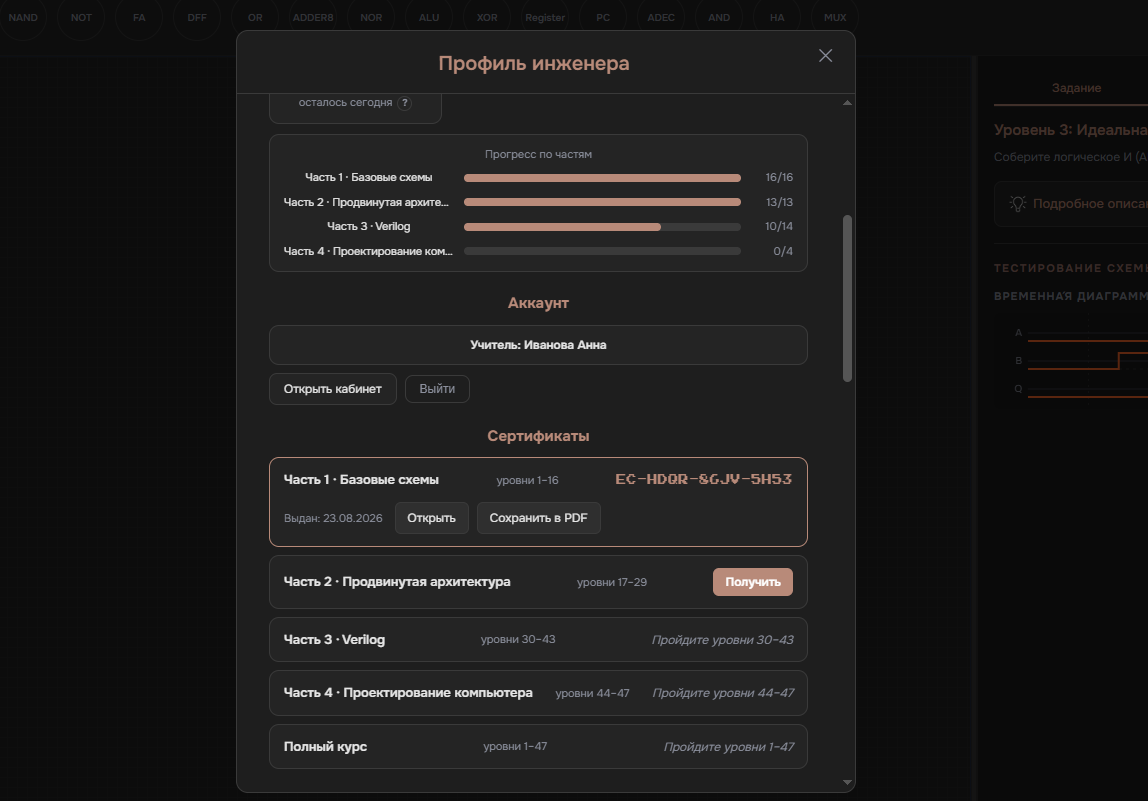
A completed level brings resources, the profile accumulates statistics and ranks, and each part of the course ends with a certificate with public verification. Moving on to the next topic rests on demonstrating mastery of the current tasks — the idea of mastery learning (Benjamin Bloom's model, 1968), only the arbiter is an automatic check rather than the calendar. The profile, ranks, resources and certificates additionally make progress visible and give the student external landmarks: the token economy works as operant reinforcement, the system described by B. F. Skinner, and a certificate records the completed part of the course and can join a portfolio.
Mistakes without punishment
A failed check takes nothing away: not resources, not access, not time. You can retry as much as you like, and error reports can be studied. This approach is consistent with the idea of a growth mindset that Carol Dweck formulated in "Mindset" (2006): a mistake is information for further learning, not a verdict on the student's ability. Technically this means every attempt produces a full diagnostic report — which vectors did not match and where exactly the circuit diverges from the table.
How checking and learning analytics work
All the mechanics above converge on automatic checking. In combinational circuits the check can cover all admissible combinations of input signals, not a couple of examples. In levels with memory, clocking and the processor, the check additionally covers behaviour over time, circuit structure (structural checkpoints — say, a requirement to build the program counter on a register) and program results (the output is compared with a reference; a successful start alone is not enough). The check returns diagnostics: which vector mismatched and what the circuit does instead of the expected behaviour.
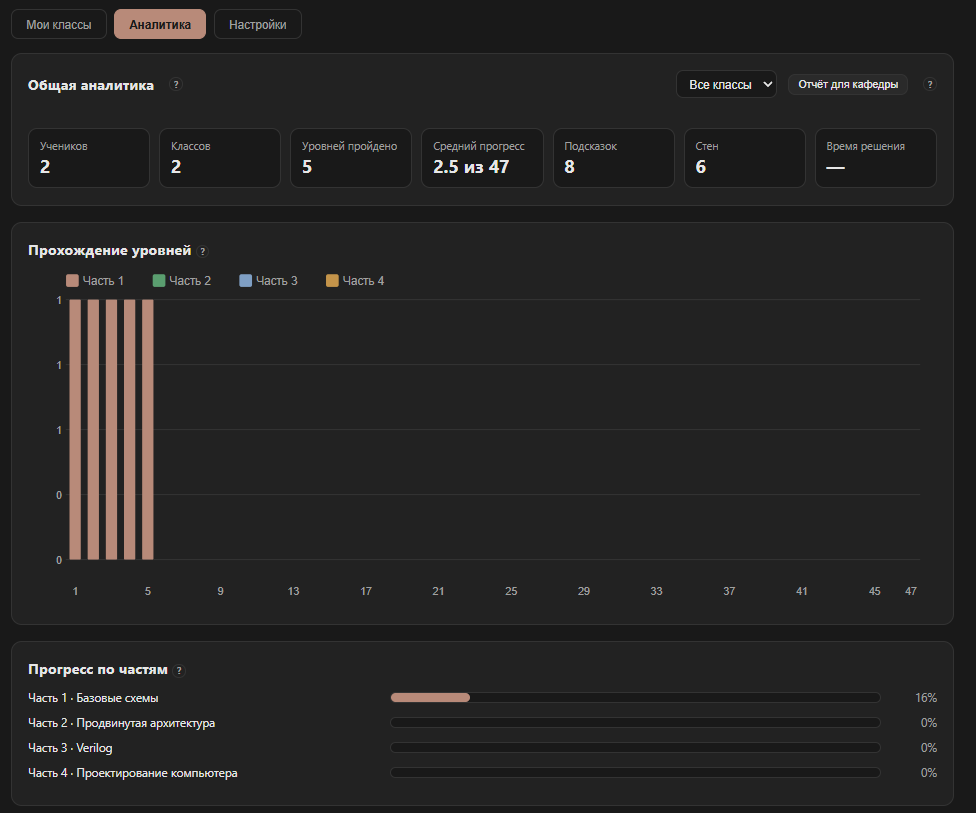
The same principle continues beyond the game. Every level in the course curriculum carries a measurable outcome ("assembles a full adder with carry-in and carry-out"), a typical time and a difficulty rating — this makes lesson planning possible and deviations visible. The teacher dashboard collects class activity and results, provides group analytics and exports a grade sheet to CSV; the completion funnel across all students shows which levels cause difficulty, and that data drives level edits. What this looks like in practice is in the teacher hub.
What to read next
This page answered the question "why does the course work". Neighbouring questions are covered separately:
- The methodology guide — how the course is built technically: the philosophy and sections of the course, the Ershov Board, the software environment, debugging tools, the final project.
- "What Makes the Ershov Computer Unique" — positioning and detailed comparisons with NandGame, Turing Complete, Nand2Tetris, CircuitVerse and HDLBits.
- Teacher hub — practice: quick start, course curriculum, methodological cards, dashboard and reporting.
- Course curriculum — the timeline of all 47 levels with topics, times and outcomes.
Common questions about the methodology
Is the Ershov Computer a game or a course?
It is a course with a game-like form. Every mechanic is tied to a measurable outcome: a level counts as completed only after an automatic check of the circuit or program against a truth table and checkpoints. Game elements (the Transistor Run platformer, the economy, the engineer profile) drive motivation; they do not replace the content.
Do I need a subject teacher?
For solo learners, no: hints, the AI tutor and automatic checks cover most questions. In a classroom, the teacher plans lessons, discusses typical mistakes and handles final assessment; the course curriculum, methodological cards and the teacher dashboard support that work.
How do I track a student's progress?
Progress is measured in completed levels, concept checks and checkpoints inside levels. The teacher dashboard shows each student's activity and results and exports a grade sheet to CSV. Certificates for each part and the full course provide an external form of assessment with public verification.
How is the course different from Nand2Tetris and NandGame?
NandGame is a puzzle, Nand2Tetris is a university course with projects and HDL. The Ershov Computer combines the route from a gate to a processor with visual circuit building, built-in theory, concept checks, a placement test and school tooling: classes, analytics and reporting. A detailed comparison is in the competitive analysis article.
Does the course fit vocational colleges and first-year students?
Yes. Levels 1–29 cover a lab course in digital logic and computer architecture, levels 30–43 work as an introduction to Verilog, and levels 44–47 take the project to a build for an FPGA board. The 27-question placement test can raise the starting level up to 30, so students with a background in circuits do not repeat material they already know.